
Martynas Stukas
Beyond the headset: learning about virtual reality in youth work
25 rgs, 19:41
For Sandra Zoomers and the team at Dutch NGO Breakthrough, experimenting with virtual reality started with a core question: what can VR add to youth work that young people cannot already get from playing games at home?
“We aim to do more than gaming,” Sandra says. “We want to achieve something with young people, either as individuals or a group.”
That principle shaped their approach. Over the past 18 months, Breakthrough has tested that ambition against the realities of the technology, working with youth work organisations across the Netherlands.
“We chat with the youth worker or the group before the session about why they want to be in virtual reality, and what they want to achieve,” Sandra explains.
That conversation means every session is different. VR isn’t the activity, but rather a new environment where youth workers can create conversations, encourage creativity, build digital skills and help young people experience ideas differently.
The results have given the team plenty of reasons to continue experimenting. And they have also learned how much work sits behind a successful VR session.
Before the experience comes the preparation
Sandra does not romanticise the technical side of VR.
She says managing the hardware was ‘hell’ at first.
Headsets need charging. Equipment needs cleaning between users. Apps need setting up and age restrictions can create problems. Plus, battery life is a serious concern, especially when several groups are taking part during one day.
Maartje Simons, one of Sandra’s co-facilitators, remembers the early days. “Setting up ten VR headsets so a group can dive in straight away used to feel like solving a puzzle every single time,” she says. “But now it's second nature.”
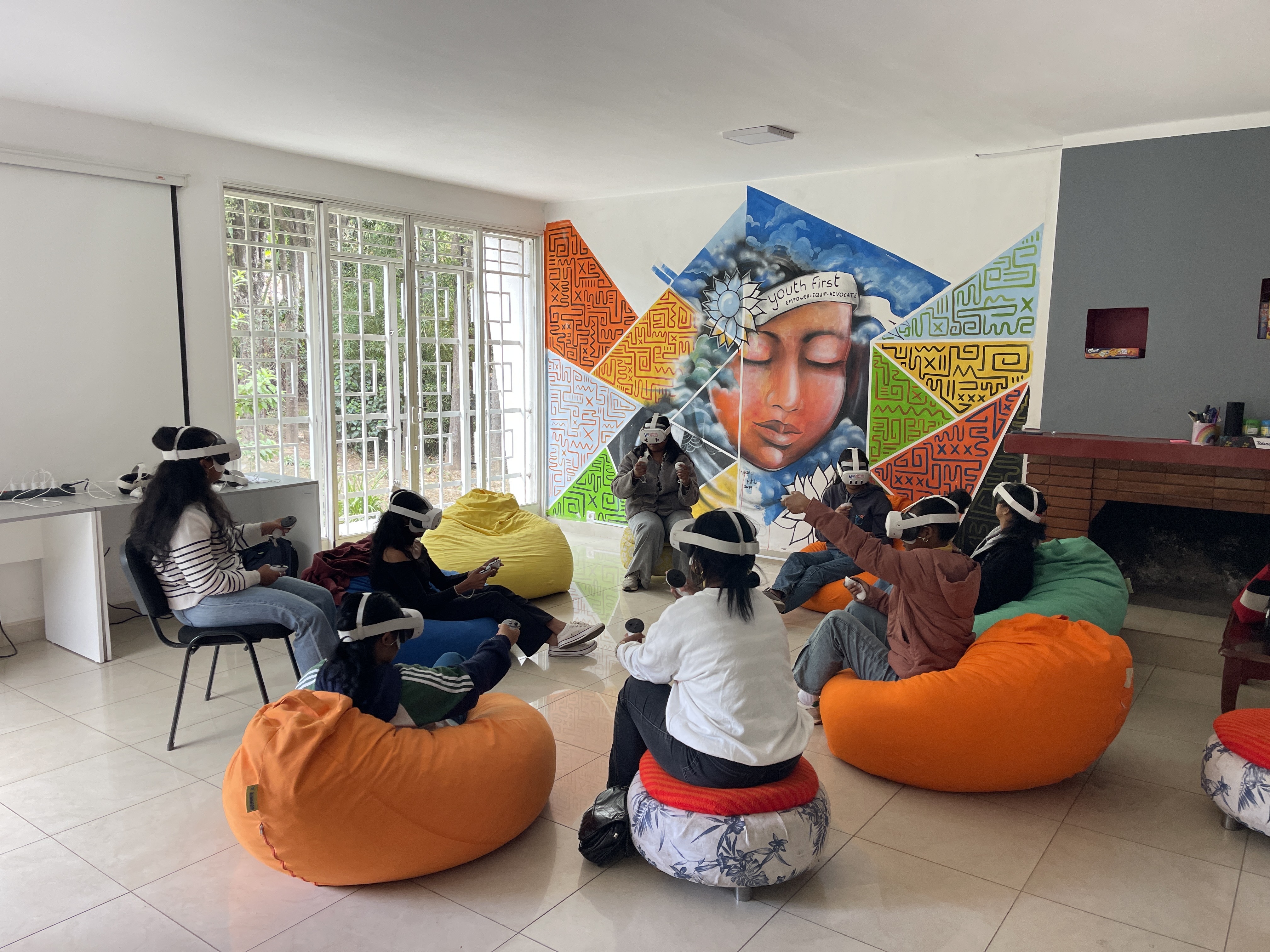
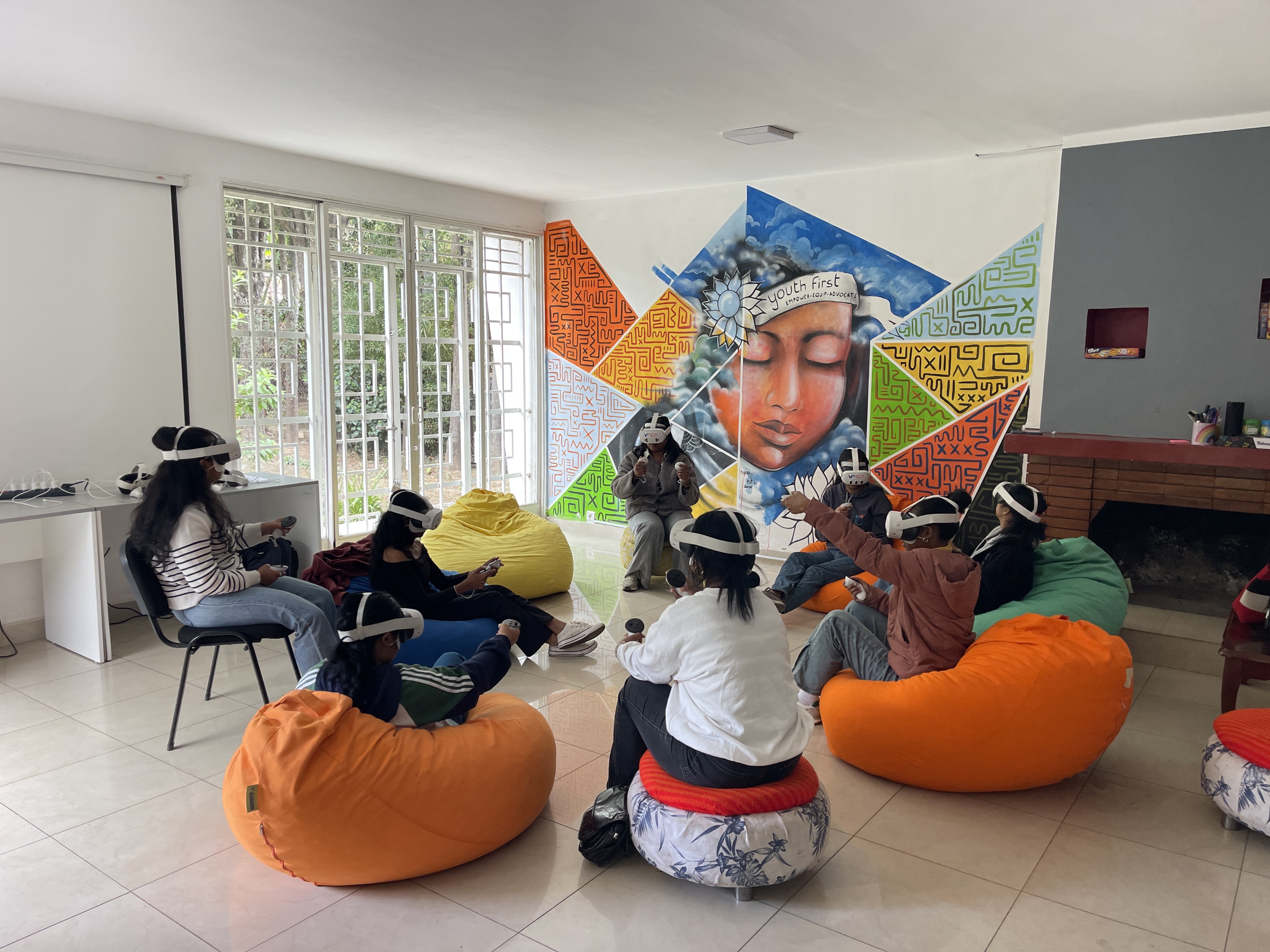
Key to a successful session is preparation and having enough youth workers in the room who are experienced using VR themselves.
Breakthrough has three people on hand for larger sessions: one focused on relationships with the young people, another managing the VR experience, and a third doing practical tasks like charging, cleaning and troubleshooting.
And Sandra, her own frustration when getting lost inside a VR environment demonstrated the need to have knowledgeable guides in the room to make it a positive experience for young people.
“By experiencing it ourselves we learned a lot about how to be inclusive, what to do and what not to do.”
For youth workers considering VR, the message is clear: use the technology yourself first. Learn where people get stuck. Know the controls. And do not underestimate the work happening outside the headset.
Make sure VR is right for the young person
Breakthrough also learned that putting everyone into VR is neither realistic nor desirable.
“Virtual reality is not for everybody,” Sandra says.
Before the headsets go on, the team spends time with the group. They ask questions and use activities that can reveal whether someone may struggle with an immersive experience.
There are physical and psychological factors to consider, including epilepsy, claustrophobia and anxiety. Age matters too. With younger children, Sandra says youth workers need to think about whether they are ready “to see the difference between real and fantasy”.
That does not mean young people who cannot use full VR need to miss out.
Breakthrough uses augmented reality as an alternative. Mixed-reality experiences can also help people who find full immersion uncomfortable because they allow users to continue seeing the physical room around them.
Maartje has seen this make a difference for anxious young people. She remembers watching them take “small steps”: putting on the headset, receiving reassurance and gradually becoming comfortable enough to play and enjoy the experience.
Digital confidence is another barrier.
“If you are not a gamer, you struggle with finding the right buttons, and it takes away all the joy,” Sandra says.
Casting the headset view onto a large screen helps. The youth worker can see exactly what the young person sees and guide them through the experience.
Sandra describes the goal simply: “How can we, as easily as possible, let a person enjoy the immersive experience?”
Accessibility here is not about getting everyone to use the technology in the same way. It is about creating different routes into the experience.
Creating experiences that start conversations
Once those foundations are in place, VR can do something more interesting. Virtual experiences can be a springboard to introduce subjects to young people they might not naturally think about, prompting meaningful conversations.
One example, the Martin Luther King experience, put young people in the shoes of a person of colour, encountering scenarios where they faced discrimination.
“It helped to open up a discussion about differences and similarities in people,” Sandra explains.
Another used the concept of a world without bees and pollinators to explore sustainability.
These were not VR experiences for their own sake. They gave young people something to react to.
Maartje remembers hearing responses from participants about subjects she knew “weren’t really on their radar” beforehand.
Reflecting on these sorts of experiences, Maartje says the technology’s emotional quality is one of its strengths. “VR is so good at making you feel something, not just see it,” she explains.
Through its experimentation, Breakthrough has also trialled using VR for creativity. Inside virtual environments young people can draw and paint in three dimensions, rather than working on a flat page.
“[It's] the wow factor,” Sandra says, describing the excitement these artistic sessions can produce.
Despite VR offering a wow, Sandra is clear that purposeful use and reflection is key to successful use of the technology.
“You need to have a clear objective for why you are using the experience,” she explains. “And you need to do something with it afterwards.”
The immersive experience opens the door. Youth work is what happens around it.
Safety starts outside the headset
Beyond the physical safety aspects of using VR, Breakthrough has learnt that behaviour both inside and outside virtual environments also needs to be carefully managed.
Young people in groups can sometimes be tempted to shout at or touch someone who is immersed, causing the person in the headset to be frightened.
“When somebody is in virtual reality in an immersive experience, everything kicks in much more,” explains Sandra. This heightening of the senses combined with an unfamiliar virtual world means if someone touches them in the real world it can “feel double scary.”
Those moments became opportunities to talk about empathy and boundaries.
Similar questions exist inside virtual environments.
Through initial VR sessions, the team quickly learned that young people wanted to take part in multi-player environments where they could collaborate. However, finding suitable collaborative platforms wasn’t straightforward.
Breakthrough was cautious about sending young people into open social VR spaces after encountering threatening language, insults and unwanted interactions.
The response was to create more controlled environments. “We decided it needed to be a safe space where people can experiment,” explains Sandra.
Through research and experimentation, the team discovered two environments where multiplayer was possible in a private environment. Track Craft allowed young people to design their own racing circuit, working together to make the track and collaborating on how it looked.
Maartje found these sorts of private environments particularly effective. Building a private space in Roblox meant young people could create together and then meet inside it without strangers entering. “Creating something together and then meeting up, chatting and playing inside it, that worked nicely.”
But safety is not only about shielding young people from digital spaces. It is also about preparing them to navigate those spaces independently.
VR gives youth workers “an opportunity to also talk about those moments and how to stay safe online”, Sandra says.
That might mean exploring consent, boundaries, online behaviour, social media or algorithms.
The difference is that young people are discussing something they have just experienced rather than an abstract online-safety scenario.
So, is VR worth it?
After all this experimentation, Sandra still does not give VR an uncomplicated endorsement.
“If I see how much work it is… that’s where my doubt is,” she says.
It takes time. The hardware can be expensive. Platforms can be frustrating. Good sessions need preparation and enough staff. And many youth work activities work perfectly well without a headset.
Yet Sandra also believes youth work needs to understand the environments young people are increasingly entering.
“Seeing how digitalised the world is becoming, I think we need to step in,” she says.
VR can create experiences that are difficult to reproduce elsewhere. It can give young people new ways to create and help them explore unfamiliar issues or topics from inside an experience rather than outside it.
Sandra also believes VR can be a tool to make distant people feel closer too, recalling using the technology to connect with colleagues in other countries.
“It felt like I was really playing face to face with them,” she explains. “It really brings someone so close that it feels like you have met for a moment.”
“There is so much more to explore,” Sandra continues.
That may be the most useful conclusion for youth workers.
VR does not make youth work innovative simply because a headset is involved. Its value depends on the purpose, the relationships, the preparation and the reflection around it.
Used thoughtfully, though, it can give young people somewhere new to create, connect, practise and question.
The headset provides an immersive space. Youth workers make it a learning space.
For organisations wanting to get started with VR, Breakthrough can offer hardware hire and hands-on support to help youth workers make the leap into the virtual world. Plus practical tools, guidelines and resources are available on the Cities of Learning Virtual Reality platform.

Funded by the European Union. Views and opinions expressed are however those of the author(s) only and do not necessarily reflect those of the European Union or the European Education and Culture Executive Agency (EACEA). Neither the European Union nor EACEA can be held responsible for them.
Note: this post was paid for by Breakthrough outside of the VR project budget.
Dalintis:

Awero palaiko šią platformą ir plėtoja ją kartu su pagrindinėmis švietimo organizacijomis. Europos Sąjungos programa Erasmus+ dalinai finansavo pirmosios platformos versijos sukūrimą. Susisiekite su mumis support@Awero.org.
Pakeisti į kitą kalbą: